

AI-Assisted Surgery: Benefits, Technology & Healthcare Software
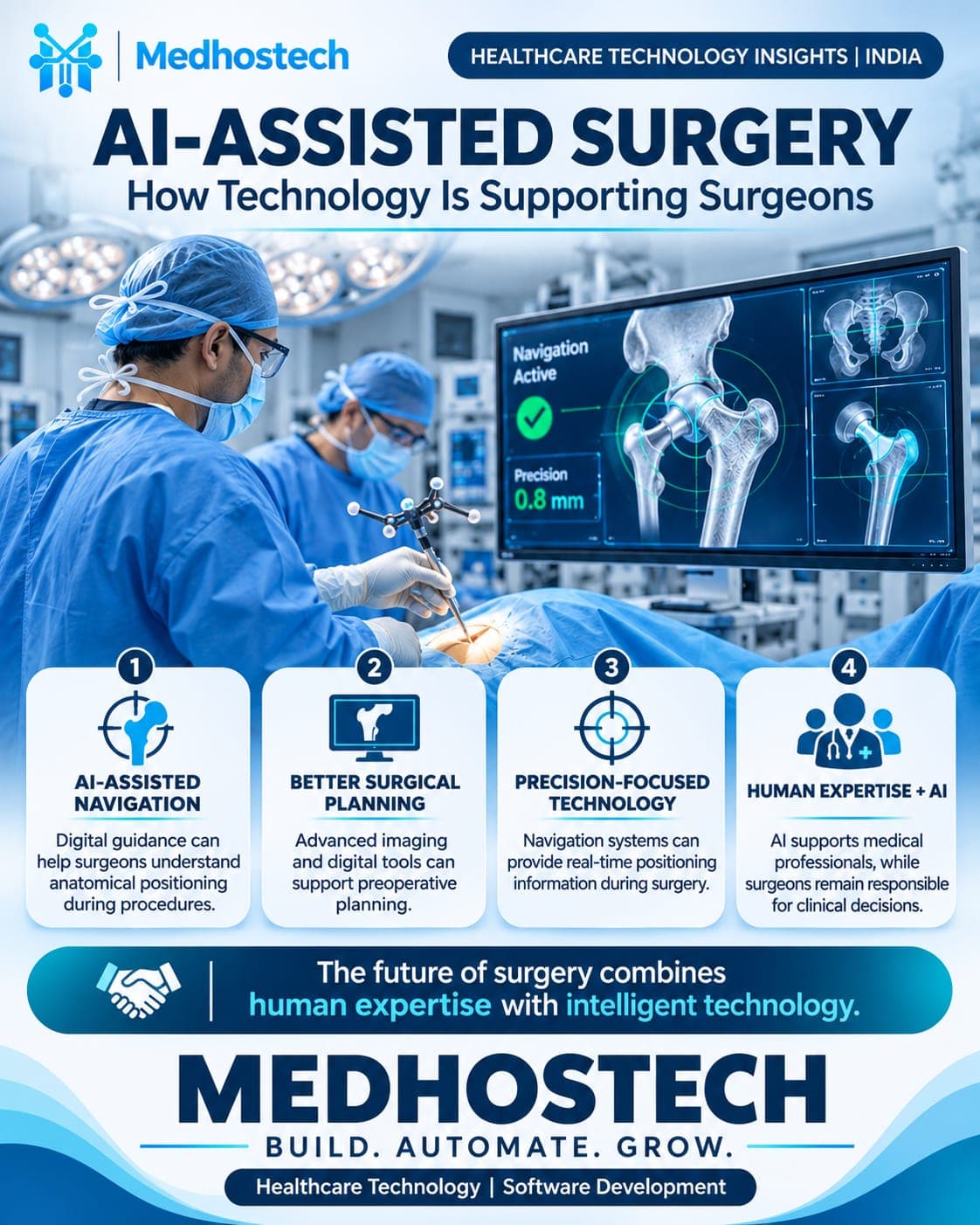
Discover how AI-assisted surgery, digital navigation and healthcare software are supporting modern surgical procedures and improving healthcare operations.
Medhostech Editorial
Healthcare IT & software insights
AI-Assisted Surgery: How Healthcare Technology Is Supporting Modern Surgeons
Introduction
Healthcare is evolving with the introduction of artificial intelligence, digital imaging and advanced medical technologies. One important development is AI-assisted surgery, where computer-based systems help surgeons plan procedures, understand anatomical structures and access useful information during operations.
These technologies are changing how medical professionals prepare for and perform certain surgical procedures. However, AI does not replace surgeons. Instead, it provides additional digital support while medical professionals remain responsible for clinical decisions.
Alongside surgical innovation, reliable healthcare software is also becoming important for managing patient information, medical records and everyday healthcare operations.
What Is AI-Assisted Surgery?
AI-assisted surgery refers to the use of artificial intelligence and computer-based technologies to support different stages of a surgical procedure.
Depending on the system, technology may help medical teams analyse medical images, plan an operation, identify anatomical structures or access navigation information during surgery.
Some procedures also use robotic-assisted surgical systems, which allow surgeons to control specialised instruments with the help of computer technology. These systems do not independently perform surgery; direct human control remains essential.
The purpose is to provide surgeons with additional information and technical assistance so they can make informed decisions.
4 Ways AI and Digital Technology Support Surgeons
1. Improved Preoperative Planning
Preparing for surgery requires careful evaluation of a patient's medical condition. Advanced imaging and computer-assisted tools can help surgeons examine anatomical structures before an operation.
Digital planning tools may help medical teams understand the surgical area, review imaging information and prepare for complex procedures.
2. Computer-Assisted Surgical Navigation
Some surgical navigation systems provide digital guidance during procedures. They can display information about the position of surgical instruments in relation to a patient's anatomy.
This information can support surgeons during specific procedures where accurate positioning is important. The technology acts as an additional source of guidance rather than making decisions independently.
3. Better Use of Medical Imaging
AI in healthcare is also being explored in medical imaging. AI-based tools can assist with analysing images such as X-rays, CT scans and MRI scans.
When appropriately validated and used by trained professionals, these tools may help identify patterns or highlight areas that need further clinical review.
4. Connected Digital Healthcare Systems
Surgical care involves more than the operation itself. Patient history, diagnostic reports, treatment information and follow-up records are important throughout the care journey.
Electronic Health Records (EHR) and integrated healthcare management software can help healthcare teams organise patient information and access relevant records.
This supports better coordination between departments and reduces dependence on scattered paperwork.
Why Healthcare Software Matters Alongside Surgical Innovation
Advanced surgical technology receives significant attention, but healthcare organisations also need dependable systems to manage their daily operations.
Modern clinic management software can support activities such as:
Patient management: Organising patient information and maintaining accessible records.
EHR and EMR systems: Managing electronic medical histories and clinical documentation.
Medical billing software: Organising billing information and payment records.
HRMS for healthcare: Supporting employee information and administrative coordination.
Cloud-based healthcare software: Helping authorised users access information across supported devices and locations.
These systems do not perform surgery or replace specialised surgical equipment. Their role is to support the administrative and information-management side of healthcare.
Why HIPAA Matters in Digital Healthcare
As healthcare organisations adopt digital systems, protecting patient information becomes essential.
HIPAA (Health Insurance Portability and Accountability Act) establishes privacy and security requirements for protected health information in the United States. Its Security Rule requires appropriate administrative, physical and technical safeguards for electronic protected health information.
Healthcare providers evaluating HIPAA-compliant healthcare software should consider access controls, user authentication, audit records, secure data transmission, risk assessments and appropriate policies.
Importantly, using cloud technology does not automatically make a system HIPAA compliant. Healthcare organisations must assess their responsibilities, the software provider's role and the safeguards in place.
The Future of AI and Healthcare Technology
The future of surgery will likely involve greater collaboration between medical expertise and intelligent technology. AI-based image analysis, computer-assisted navigation and digital planning tools may continue to develop as healthcare professionals evaluate their usefulness and safety.
At the same time, connected healthcare software solutions will remain important for managing patient records, coordinating teams and organising clinical operations.
At Medhostech, we recognise the importance of technology in modern healthcare. Our focus on cloud-based healthcare management solutions supports healthcare organisations with tools for patient management, EHR, EMR, medical billing and HRMS. The goal is to help clinics organise their operations through connected digital systems.
Frequently Asked Questions (FAQs)
1. What is AI-assisted surgery?
AI-assisted surgery uses artificial intelligence and computer-based tools to support surgeons with tasks such as medical image analysis, surgical planning and navigation.
2. Can AI perform surgery without a surgeon?
No. AI-assisted and robotic-assisted surgical systems are designed to support medical professionals. Surgeons remain responsible for controlling procedures and making clinical decisions.
3. How does healthcare software support surgical care?
Healthcare software helps organise patient records, medical histories, clinical documentation, billing and administrative information. It supports healthcare operations before and after procedures.
4. Why is HIPAA important for healthcare software?
HIPAA establishes requirements for protecting patient health information in the United States. Healthcare organisations must use appropriate safeguards to protect electronic protected health information and manage access securely.
5. What should clinics look for in healthcare management software?
Clinics should evaluate patient management, EHR and EMR capabilities, billing features, staff management, data security, usability and the ability to support their operational needs.
Conclusion
AI-assisted surgery demonstrates how technology can support modern medical professionals through digital planning, imaging and surgical navigation. However, successful healthcare transformation also depends on organised patient information, secure digital systems and efficient daily operations.
By combining medical expertise with reliable healthcare software, healthcare organisations can build a more connected and technology-enabled environment.
Medhostech — Build. Automate. Grow.