
Best Healthcare Management Software in India: Essential Features
Discover the best healthcare management software in India. Explore essential HRMS, EHR, billing and clinic management features that improve hospital operations.
Medhostech Editorial
Healthcare IT & software insights
Best Healthcare Management Software in India: Features Every Modern Hospital Needs
The healthcare industry in India is evolving rapidly. Hospitals, clinics, diagnostic centres and other healthcare providers are increasingly adopting digital solutions to manage their daily operations more efficiently. From maintaining patient records to managing employees, billing and administrative tasks, technology is becoming an essential part of modern healthcare.
However, managing multiple departments through separate systems can create communication gaps, duplicate work and administrative delays. This is why healthcare organisations are looking for integrated solutions that bring important operations together on a single platform.
Choosing the best healthcare management software in India is not just about finding a tool to manage patients. It is about selecting a reliable system that supports hospital administration, improves coordination, simplifies financial operations and helps healthcare professionals focus more on patient care.
But what features should modern hospitals look for before investing in a healthcare management solution? Let's explore.
Why Do Modern Hospitals Need Healthcare Management Software?
Traditional hospital management often involves paperwork, spreadsheets and disconnected software systems. As a healthcare organisation grows, these methods can become difficult to manage.
For example, the HR department may maintain employee attendance separately, the billing department may use another system, and patient information may be stored in different records.
An integrated hospital management system helps connect these activities and provides better operational visibility.
Some important benefits include:
Centralised operations: Manage multiple administrative activities through one platform.
Better coordination: Improve information sharing between departments.
Reduced manual work: Automate repetitive administrative processes.
Improved record management: Organise important business and patient information.
Operational visibility: Access relevant information to support better decisions.
For Indian hospitals, these capabilities can be particularly valuable when managing growing teams, multiple departments and increasing administrative responsibilities.
1. Essential Features to Look for in Healthcare Management Software
Not every software solution offers the same capabilities. Before selecting a platform, hospitals should evaluate the features that match their operational requirements.
A. HRMS Software for Employee Management
Managing doctors, nurses, receptionists, technicians and administrative employees requires proper coordination.
A good HRMS software solution can simplify workforce management by supporting:
Employee information and staff records.
Attendance and shift management.
Payroll processing.
Leave and holiday management.
Employee performance tracking.
These features help healthcare administrators manage their workforce systematically and reduce repetitive HR tasks.
B. EHR Software for Digital Patient Records
Patient information is one of the most important parts of healthcare operations. Maintaining physical files can make retrieving historical information time-consuming.
EHR software (Electronic Health Record software) helps healthcare providers maintain structured digital patient information, such as medical history, diagnoses, prescriptions and treatment records.
When evaluating EHR capabilities, hospitals should consider:
Secure storage of patient information.
Easy access to authorised medical records.
Proper data organisation.
Record-sharing capabilities where supported.
Backup and access-control mechanisms.
India's Ayushman Bharat Digital Mission (ABDM) is also encouraging the development of an interconnected digital healthcare ecosystem. Hospitals should evaluate whether their chosen software supports relevant ABDM standards and integrations.
C. Integrated Billing and Financial Management
Billing errors and disconnected financial records can create unnecessary administrative challenges. Modern healthcare software should support organised billing workflows, invoice generation, payment tracking and financial reporting. Integration between billing and other operational modules can help minimise duplicate data entry and improve financial visibility.
D. Patient and Clinic Management
For hospitals and smaller healthcare facilities, managing patient information and daily administrative activities is equally important.
The best clinic management software should offer features such as:
Patient registration and profile management.
Appointment and visit records.
Consultation information.
Patient history management.
Reports and administrative tracking.
The right solution should be easy to navigate and adaptable to the clinic's size and workflow.
2. Why Cloud-Based Healthcare Software Is Becoming Important
Cloud technology allows authorised users to access software through internet-connected devices without depending entirely on a single local computer.
For growing healthcare organisations, cloud-based solutions can offer several operational advantages.
Accessibility: Authorised employees can access relevant information from different locations.
Scalability: Organisations can evaluate plans and features as their requirements grow.
Centralised information: Different departments can work with information maintained within a connected system.
Maintenance: Software updates and infrastructure management may be handled by the provider, depending on the service agreement.
However, hospitals should always check data hosting, encryption, access controls, backup policies and applicable privacy requirements before choosing a cloud platform.
3. How to Choose the Best Software Tool for Your Hospital
Selecting the best software tool requires more than comparing prices or counting features. Healthcare organisations should consider their daily challenges and long-term requirements.
Here are five important factors:
Understand your requirements: Identify whether you need HRMS, billing, patient management, EHR or an integrated solution.
Check integration capabilities: Ensure different modules can communicate without unnecessary duplicate work.
Evaluate data security: Check user permissions, encryption, backups and data protection practices.
Consider ease of use: Choose an interface that employees can learn without extensive technical knowledge.
Compare support and scalability: Review customer support, onboarding, pricing and future expansion options.
Hospitals should also request a product demonstration before making a final decision. A practical demo helps teams understand how the software works in their actual environment.
4. The Role of Digital Healthcare in India's Future
India's digital healthcare ecosystem is developing through initiatives such as the Ayushman Bharat Digital Mission. The mission aims to support digital health records and improve interoperability between healthcare stakeholders. Its ecosystem includes ABHA, the Healthcare Professionals Registry and the Health Facility Registry. For hospitals investing in digital infrastructure, this makes interoperability and secure information exchange important considerations when evaluating software. National Government Services Portal+1
For additional information, visit the official Ayushman Bharat Digital Mission website.
5. Why Integrated Software Is a Better Choice
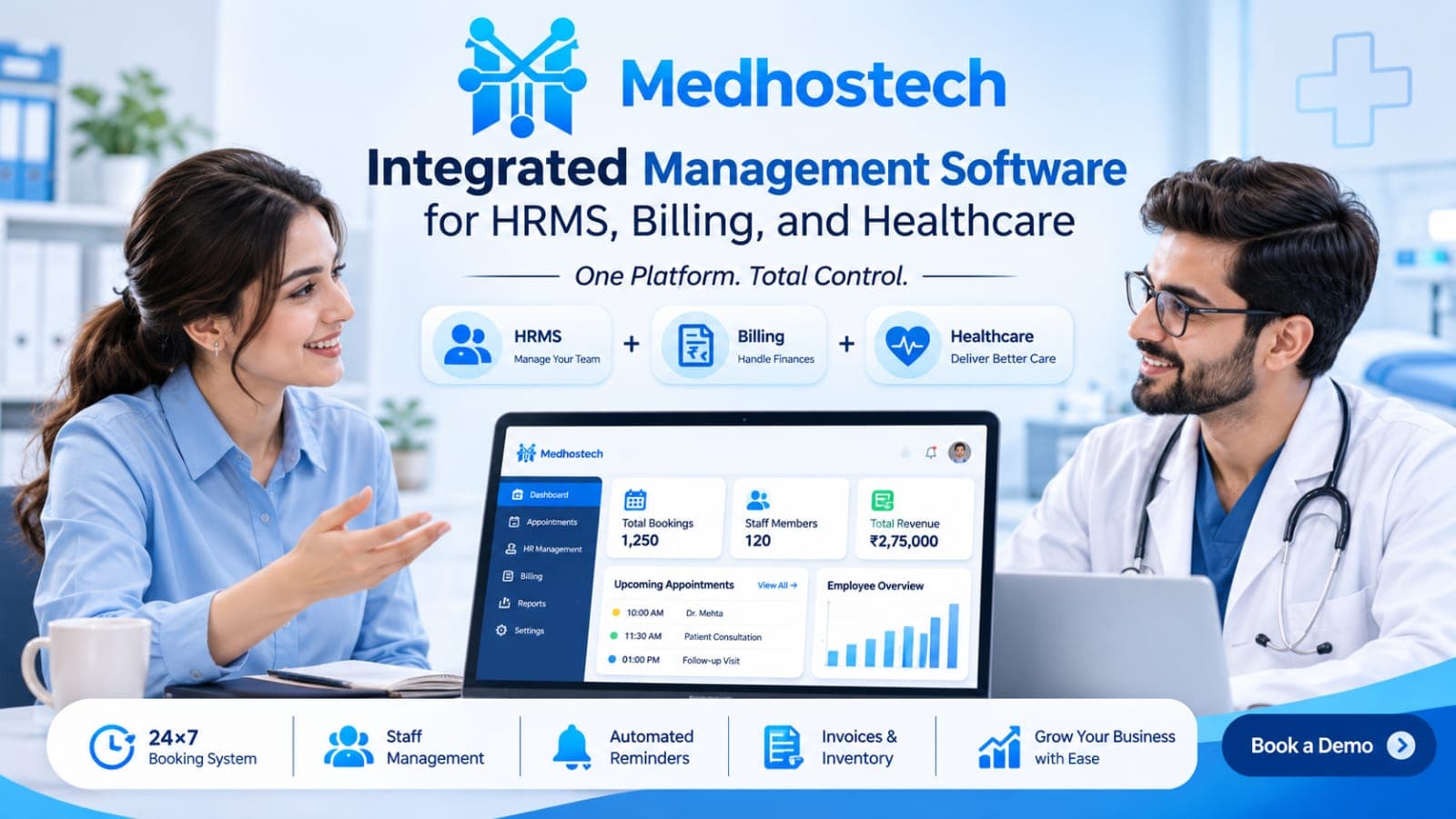
Using separate tools for HR, billing, patient information and administration can increase complexity as a healthcare organisation grows. An integrated platform brings essential business functions into a connected environment. This can make information management easier and help administrators monitor different operations more effectively. For example, when HRMS, billing and patient management functions are connected, hospital administrators can manage workforce activities and administrative workflows with better coordination.
Medhostech aims to simplify business operations through integrated digital management solutions. Healthcare organisations can explore its software capabilities to understand how centralised management can support their operational requirements.
Frequently Asked Questions (FAQs)
1. What is healthcare management software?
Healthcare management software is a digital solution that helps hospitals, clinics and healthcare organisations manage administrative activities, patient information, billing, employees and other operational processes.
2. Which is the best healthcare management software in India?
The best solution depends on the organisation's size, requirements, budget, security expectations and integration needs. Hospitals should compare features, usability, scalability and customer support before choosing.
3. What features should hospital management software include?
Important features may include patient management, billing, employee management, reporting, digital records, inventory management and administrative automation.
4. How does HRMS software help hospitals?
HRMS software helps hospitals manage employee records, attendance, payroll, leave requests and workforce-related activities through a centralised system.
5. What is the difference between EHR software and hospital management software?
EHR software primarily focuses on maintaining electronic patient health records. Hospital management software covers broader hospital operations, which may include administration, billing, patient management and other departments.
6. Is cloud-based healthcare software suitable for small clinics?
Yes. Cloud-based solutions can be suitable for small clinics because they offer flexible access and can reduce the need to maintain extensive local IT infrastructure. The clinic should still evaluate security, pricing and internet requirements.
7. How can hospitals select the right healthcare software?
Hospitals should identify their operational needs, compare available features, evaluate data security, check integration options and request a software demonstration before making a decision.
Conclusion
Choosing the best healthcare management software in India is an important step towards building organised, efficient and technology-driven healthcare operations. From HRMS software and EHR solutions to billing and clinic administration, the right digital tools can help healthcare organisations reduce manual workloads and improve coordination between departments.
Rather than selecting software based only on popularity, hospitals should prioritise functionality, security, scalability and ease of use. Looking to simplify your healthcare business operations?
Explore Medhostech to discover integrated management solutions designed to help businesses organise their operations, manage teams and improve administrative efficiency.
Visit: www.medhostech.com