
How Oklahoma Clinics Can Simplify Payroll and HR Management
Discover how Oklahoma clinics can simplify employee payroll, HR, billing, and EHR management with cloud-based healthcare software.
Medhostech Editorial
Healthcare IT & software insights
How Can Oklahoma Clinics Simplify Employee Payroll and HR Management With Healthcare Software?
Managing a healthcare clinic involves more than treating patients. Behind every successful clinic is a team responsible for patient care, administration, billing, employee coordination, and daily operations. For healthcare providers in Oklahoma, handling all these responsibilities manually can become challenging, especially as the clinic grows.
Employee attendance, payroll calculations, leave management, staff scheduling, and maintaining accurate employee records require time and consistent attention. When these activities are managed through separate spreadsheets and applications, administrative teams may struggle to maintain accurate information.
Healthcare management technology offers a practical way to simplify these responsibilities. By adopting integrated software, clinics can organize workforce information, streamline administrative processes, and improve operational efficiency.
Let's understand how healthcare software can help Oklahoma clinics manage payroll and HR more effectively.
1. Why Do Oklahoma Clinics Need Digital Payroll and HR Management?
Healthcare clinics depend on employees working across different shifts and departments. Managing their schedules, attendance, salaries, and leave records manually can create unnecessary administrative work.
Common workforce management challenges include:
Incorrect attendance and working-hour records.
Delays in processing employee payroll.
Difficulty managing staff schedules and leave requests.
Scattered employee information.
Limited visibility into workforce performance.
Digital HR management systems help clinics maintain organized employee records and reduce repetitive administrative activities.
For example, a healthcare clinic in Oklahoma City can use centralized software to monitor attendance, maintain employee information, and organize payroll-related records instead of relying entirely on manual documentation.
2. How Can Healthcare Software Simplify Payroll and HR Operations?
Healthcare software can bring important workforce management activities into one digital environment.
Some useful features include:
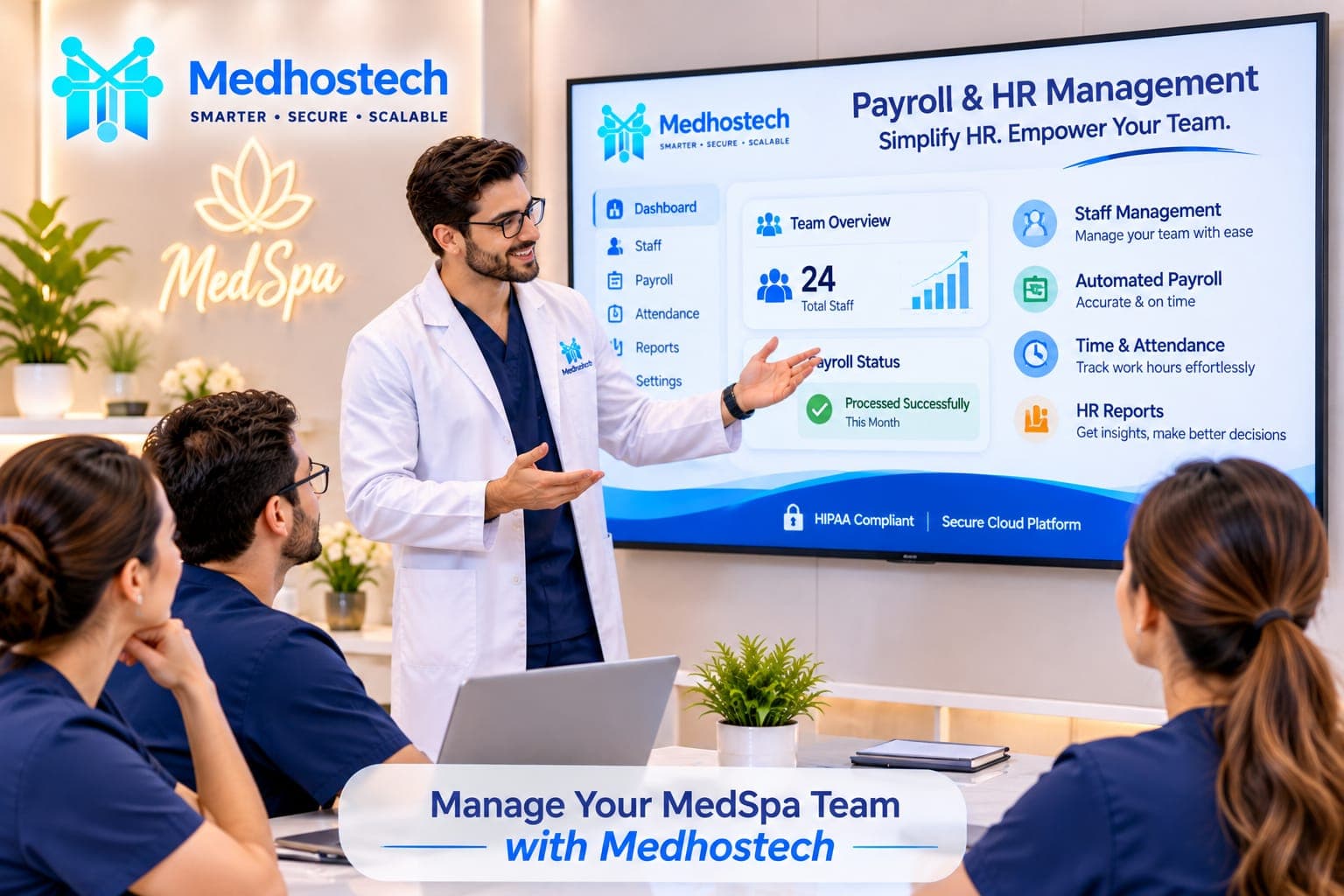
Employee Information Management: Maintain employee profiles, job details, department information, and employment records.
Attendance Tracking: Record employee working hours and monitor attendance more systematically.
Leave Management: Organize leave requests, approvals, and available leave information.
Payroll Management: Maintain salary information, working hours, deductions, and payroll records.
Staff Scheduling: Organize employee shifts and help managers maintain appropriate workforce coverage.
These capabilities can help administrative teams spend less time managing paperwork and more time focusing on essential clinic operations.
3. How Does EHR Software Support Healthcare Clinic Operations?
EHR software (Electronic Health Record software) helps healthcare providers maintain and access patient medical information digitally. Although EHR and HR management serve different purposes, both are important for modern healthcare operations.
EHR systems generally support:
Digital patient medical records.
Medical history management.
Clinical documentation.
Authorized information access.
Healthcare information exchange.
In Oklahoma, the statewide OKSHINE initiative supports secure health information exchange between healthcare providers. It aims to improve access to relevant patient information and address interoperability challenges between different EHR systems.
Clinics should therefore evaluate whether their selected EHR software supports appropriate interoperability and integration with their existing healthcare systems.
4. Why Is Cloud Hosting Important for Healthcare Software?
Traditional software may depend on locally installed systems, which can limit accessibility and make maintenance more complicated. With cloud Hosting, healthcare organizations can access supported software and information through internet-connected devices.
Some important advantages include:
Remote accessibility: Authorized managers can access relevant workforce information without being physically present in the clinic.
Centralized information: Employee records and operational information can be maintained in a connected environment.
Reduced paperwork: Digital processes can reduce repetitive manual documentation.
Scalability: Clinics can evaluate solutions that accommodate additional employees and locations.
However, clinics handling protected health information must evaluate security safeguards carefully. HHS explains that cloud service providers maintaining electronic protected health information may qualify as business associates and generally require an appropriate Business Associate Agreement (BAA).
HHS.gov+1
5. How Can Billing Software Improve Administrative Efficiency?
Payroll is not the only financial responsibility healthcare clinics need to manage. Patient billing, invoice generation, payment tracking, and financial reporting are also important.
Billing software can help clinics:
Generate and organize invoices.
Track completed and pending payments.
Maintain digital billing records.
Monitor outstanding balances.
Review financial reports.
When billing and workforce management are organized through connected systems, clinic administrators can gain better visibility into different operational activities.
Before choosing a solution, clinics should check whether its billing features support their existing payment processes and accounting requirements.
6. How to Choose the Best Employee Management Software in Oklahoma?
Finding the Best employee management software in Oklahoma depends on the clinic's workforce size, administrative requirements, and operational structure.
Before selecting a platform, consider these factors:
Essential features: Check attendance, payroll, employee records, and leave management.
Ease of use: Employees and administrators should be able to navigate the system easily.
Data security: Review access permissions, authentication, and information protection.
Integration: Check compatibility with existing EHR and billing systems.
Scalability: Choose software that can accommodate future workforce expansion.
Customer support: Evaluate the availability of technical assistance and employee training.
The right platform should solve actual administrative problems rather than introduce unnecessary complexity.
Frequently Asked Questions (FAQs)
1. How can healthcare clinics in Oklahoma automate employee payroll?
Healthcare clinics can use payroll management software to organize employee salary information, working hours, deductions, and payroll records. Automation can reduce repetitive calculations and help maintain more consistent payroll processes.
2. What features should HR software for healthcare clinics include?
Healthcare HR software should include employee records, attendance tracking, shift scheduling, leave management, payroll support, and workforce reporting. These features help administrators manage employees more efficiently.
3. Is cloud-based healthcare software suitable for small clinics in Oklahoma?
Yes. Cloud-based software can help small clinics access supported business information, organize employee records, and simplify administrative workflows. Clinics should evaluate security, scalability, and applicable compliance requirements before adoption.
4. What is the difference between EHR software and HR management software?
EHR software manages electronic patient health records, including medical histories and clinical documentation. HR management software focuses on employees, attendance, payroll, leave, and workforce administration. Both support different aspects of healthcare operations.
5. Can one healthcare software platform manage payroll, HR, and billing?
Yes. Some integrated healthcare management platforms offer employee management, payroll, and billing capabilities within one environment. However, clinics should verify the available modules and integrations before selecting a platform.
Conclusion: Simplify Healthcare Management With Medhostech
Managing employee payroll, HR responsibilities, billing, and patient information separately can increase administrative pressure on healthcare clinics. As healthcare organizations grow, maintaining organized systems becomes increasingly important.
The right healthcare management technology can help clinics reduce manual work, improve employee coordination, maintain organized records, and streamline everyday operations.
Medhostech offers SaaS-based, cloud-based business management solutions designed to help businesses organize essential operational activities through digital technology. For healthcare clinics in Oklahoma looking to improve workforce management and simplify administrative processes, exploring integrated management solutions can be a practical step towards digital transformation.
Medhostech – Build. Automate. Grow.
Explore more at www.medhostech.com.