
Digital Twins in UK Healthcare: Personalised and Predictive Care
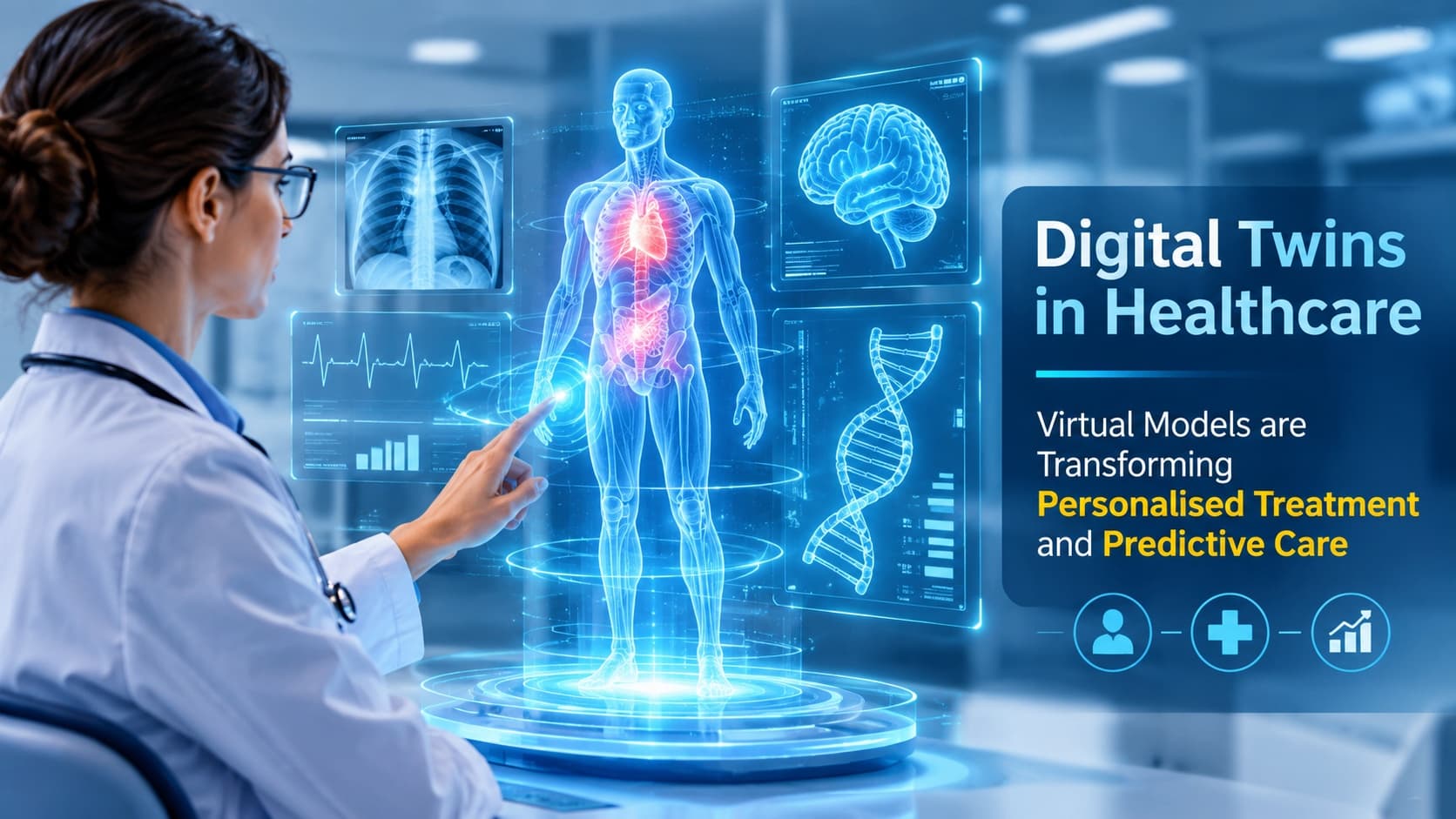
Discover how digital twins are transforming UK healthcare through personalised treatment, medical simulations and predictive care, and what healthcare providers need to prepare.
Medhostech Editorial
Healthcare IT & software insights
Digital Twins in UK Healthcare: How Virtual Models Are Transforming Personalised Treatment and Predictive Care
Introduction
What if doctors could test different treatment options on a virtual model of a patient before making decisions about their real-world care? This is the idea behind digital twins in healthcare, an emerging technology that could transform how medical professionals understand diseases, plan treatments and monitor patient health.
Across the UK, healthcare innovation is increasingly focused on personalised medicine, connected health data and predictive care. Digital twins bring these developments together by creating virtual representations of patients, organs or specific biological processes using medical information, imaging, monitoring devices and advanced computer modelling.
Although this technology is still developing and is not yet part of routine care everywhere, UK research organisations are exploring its potential to improve clinical decision-making and healthcare delivery.
What Are Digital Twins in Healthcare?
A healthcare digital twin is a virtual model of a patient's body, organ or biological system. It uses information such as medical history, diagnostic images, laboratory results and wearable-device data to represent aspects of a person's health.
Unlike a basic digital record, a digital twin can use simulations and predictive models to explore how a particular condition might develop or how the body could respond to different interventions.
For example, a virtual model of a patient's heart could help researchers investigate blood flow, understand changes in cardiac function and explore possible treatment scenarios.
The Alan Turing Institute has highlighted the potential of connected digital twins for personalised healthcare, including research into virtual heart models for people with pulmonary arterial hypertension.
5 Ways Digital Twins Could Transform UK Healthcare
1. Personalised Treatment Based on Individual Health Data
Every patient responds differently to medication, treatment and lifestyle changes. Traditional treatment approaches often rely on clinical guidelines and population-level evidence, but digital twins could add another layer of personalisation.
By combining medical records, scans, test results and other relevant health information, a patient-specific model could help clinicians explore possible treatment responses.
For example, in cardiology, a digital heart model could help researchers simulate how changes in blood flow or cardiac function might affect an individual patient.
This could support more informed discussions between clinicians and patients, helping healthcare move towards more personalised treatment planning.
2. Medical Simulations Before Real-World Procedures
Medical simulations allow healthcare professionals to explore possible outcomes in a controlled virtual environment.
Digital twins could support this process by modelling specific organs, conditions or physiological processes. Surgeons and specialists may be able to use these models to study complex cases, assess potential risks and compare different approaches before carrying out a procedure.
In areas such as cardiology, oncology and surgical planning, this could help professionals understand complex patient-specific conditions.
However, simulations should support clinical expertise rather than replace professional judgement. Their reliability depends on the quality of the underlying data and the accuracy of the model.
3. Predictive Healthcare and Early Risk Identification
One of the most promising applications of digital twins is predictive healthcare.
By analysing changes in patient data over time, predictive models could help identify patterns associated with worsening health conditions. This may support earlier clinical review and more proactive care planning.
For example, a model using relevant cardiac measurements and monitoring data could help researchers investigate indicators of changing heart function.
For healthcare providers, the wider opportunity is to move from responding only when a patient becomes unwell towards identifying potential risks earlier.
Digital twins are not a guarantee of disease prevention or accurate predictions. Their performance must be properly tested before being used to influence clinical decisions.
4. Better Management of Long-Term Health Conditions
Managing long-term conditions often requires information from multiple sources, regular monitoring and coordination between healthcare professionals.
Digital twins could help bring different types of patient information together to create a more complete picture of an individual's health.
This may be particularly useful in areas such as diabetes, cardiovascular disease and respiratory conditions, where health indicators can change over time.
For healthcare organisations, connected digital records and an effective care management system can help teams organise patient information, coordinate care activities and maintain continuity.
It is important to distinguish between clinical digital twins and operational care software: a care management platform does not automatically create a medical digital twin, but organised and accessible information can support better-connected healthcare workflows.
5. Smarter Healthcare Operations and Service Planning
Digital twin technology is not limited to modelling individual patients. It can also be used to simulate healthcare services and operational processes.
For example, researchers could create virtual models of hospital departments or diagnostic services to examine patient flow, staffing requirements and resource allocation.
In March 2026, the University of Sheffield announced the RESHAPE-CARE research project, which aims to use virtual simulations to explore improvements in NHS services for people with multiple long-term conditions.
This demonstrates how digital twin approaches could support not only personalised medicine but also the planning and delivery of healthcare services.
What Healthcare Providers Need Before Adopting Digital Twin Technology
Successful digital healthcare innovation requires more than advanced algorithms. Healthcare organisations need reliable systems, accurate information and secure ways to manage patient data.
Some important considerations include:
Connected patient records: Information from different systems should be accessible and organised appropriately.
Data security: Patient information must be handled in line with UK GDPR, the Data Protection Act 2018 and applicable healthcare requirements.
System integration: New technologies should work effectively with existing clinical and administrative systems.
Data quality: Incomplete or inaccurate information can affect the reliability of predictive models.
Clinical validation: Models must be evaluated carefully before being used to support real clinical decisions.
Healthcare providers should also assess whether their existing technology can support future digital transformation.
Choosing the best healthcare management software involves evaluating more than basic administrative features. Providers should consider reporting, data management, security, integration capabilities and the ability to support efficient workflows.
For independent clinics, Private practice management software UK searches often reflect a need for better patient administration, organised records, billing and day-to-day practice operations. Similarly, organisations comparing EHR software UK and clinic management software UK should understand the difference between clinical record capabilities and operational management features.
How Medhostech Supports the Move Towards Connected Healthcare
As healthcare becomes increasingly technology-driven, clinics need reliable digital systems to manage everyday operations and information efficiently.
Medhostech focuses on software solutions designed to support healthcare and business management workflows. An organised digital environment can help healthcare teams manage operational activities, reduce fragmented processes and improve access to relevant business information.
While healthcare management software is not a digital twin platform, it can form part of the wider digital infrastructure that organisations evaluate as they prepare for more connected healthcare services.
The goal is to help healthcare businesses build more organised, efficient and technology-ready operations.
Frequently Asked Questions
1. What is a digital twin in healthcare?
A digital twin in healthcare is a virtual model of a patient, organ or biological system that uses health data and computer modelling to simulate conditions, explore treatment possibilities and support predictive analysis.
2. How can digital twins support personalised medicine?
Digital twins can combine patient-specific information, such as medical images, test results and health records, to model individual conditions. This may help clinicians and researchers explore treatment scenarios and understand possible patient responses.
3. Are digital twins currently used in the NHS?
Digital twin technology is being explored through UK research initiatives, including projects involving cardiac modelling and virtual simulations of healthcare services. However, it is not yet a standard tool across all NHS hospitals and clinical settings.
4. Can digital twins predict diseases?
Digital twins may help identify patterns and estimate how certain health conditions could develop. However, predictions depend on data quality, model accuracy and clinical validation. They should not be treated as guaranteed diagnoses.
5. What is the difference between a digital twin and an EHR system?
An Electronic Health Record (EHR) system stores and organises patient health information. A digital twin uses relevant data to create a virtual model that can simulate or analyse aspects of a patient's health. An EHR may provide information used to develop a digital twin, but the two technologies serve different purposes.
6. Why do private clinics need healthcare management software?
Private clinics need healthcare management software to organise administrative activities, patient information, billing, reporting and daily workflows. The right solution can reduce manual processes and help teams manage operations more efficiently.
7. What should UK healthcare providers look for in healthcare management software?
UK healthcare providers should evaluate data security, GDPR compliance, reporting, integration options, patient-record management, usability and scalability. They should also check whether the software is suitable for their specific organisation, whether that is a private clinic, GP practice or care provider.
Conclusion
Digital twins could play an important role in the future of UK healthcare by supporting personalised treatment, medical simulations, predictive analysis and smarter healthcare planning.
However, their successful adoption will depend on reliable data, secure digital infrastructure, clinical validation and effective collaboration between healthcare professionals and technology providers.
For healthcare organisations, preparing for this future starts with building a connected and well-managed digital environment. The combination of responsible AI, organised health information and effective management systems could help create a more proactive and patient-centred healthcare landscape.
Medhostech – Build. Automate. Grow.