
Healthcare Clinic Challenges in Rhode Island, USA | Management Software
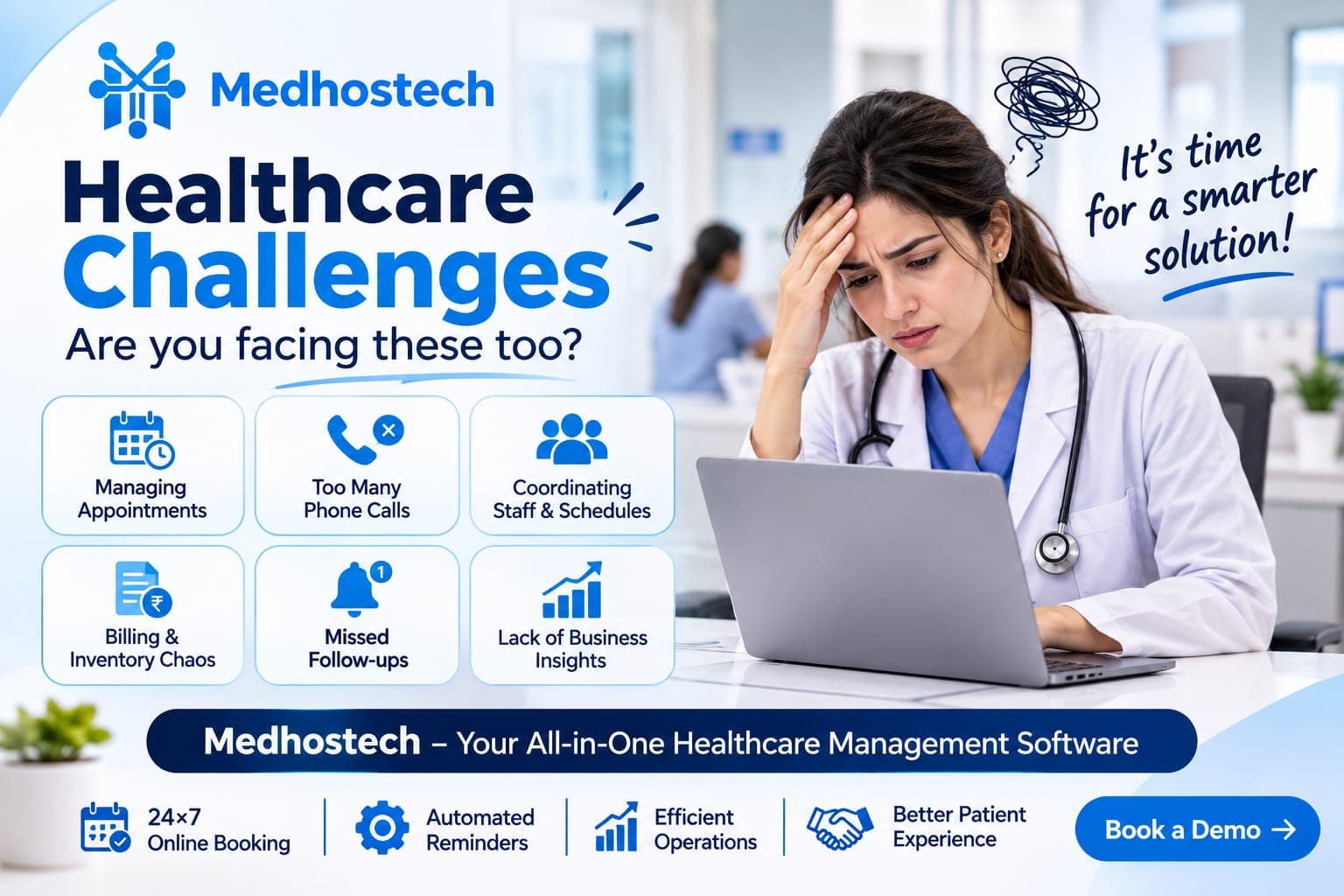
Explore the biggest operational challenges faced by healthcare clinics in Rhode Island and how healthcare management software can simplify billing, HRMS, and daily operations.
Medhostech Editorial
Healthcare IT & software insights
What Are the Biggest Operational Challenges Faced by Healthcare Clinics in Rhode Island, USA?
Healthcare clinics in Rhode Island play an important role in providing accessible and reliable medical services to local communities. However, running a healthcare facility involves much more than treating patients. Clinic administrators and healthcare professionals must manage employee schedules, patient records, billing activities, administrative responsibilities, and everyday operations while maintaining a smooth patient experience.
For many healthcare clinics in Rhode Island, managing these responsibilities through separate systems or manual processes can create unnecessary complications. Staff members may spend valuable time handling paperwork, tracking payments, updating records, and coordinating internal activities instead of focusing on patient care.
As healthcare operations become increasingly technology-driven, clinics are exploring digital solutions to improve efficiency and simplify administrative work. Healthcare management software in Rhode Island, USA, can help clinics organize essential business processes through a more connected and structured system.
Understanding these operational challenges is the first step toward building a more efficient and well-managed healthcare practice.
1. Managing Patient Information and Medical Records
One of the major operational challenges for healthcare clinics is maintaining accurate and organized patient information. Clinics handle different types of records, including patient details, medical histories, consultation information, and treatment documentation.
When information is stored across multiple systems or maintained manually, retrieving updated records can become time-consuming. Missing information, duplicate entries, and communication gaps may also affect administrative efficiency.
Digital healthcare solutions can help clinics organize patient information and improve access to relevant records. Depending on the system and its integrations, healthcare professionals can manage patient details more systematically.
A suitable Clinic management software in Rhode Island can support better information organization, reduce repetitive administrative tasks, and help clinic staff manage daily activities more efficiently.
2. Medical Billing and Payment Management
Billing is another important responsibility that requires accuracy and proper coordination. Healthcare clinics handle consultation charges, treatment fees, insurance-related processes, payment records, and outstanding balances.
Managing these activities manually can increase the chances of calculation errors, delayed payment tracking, and incomplete financial records.
For clinics with multiple healthcare professionals or services, keeping billing information organized becomes even more important.
Using Medical billing software in Rhode Island can help healthcare facilities organize billing records, generate invoices, track payments, and maintain clearer financial information.
Automated billing processes can also reduce repetitive data entry and help administrative teams spend less time on routine financial activities.
However, clinics should ensure that their chosen billing solution supports their specific requirements, including relevant insurance workflows and applicable healthcare regulations.
3. Employee Scheduling and Workforce Management
Healthcare clinics depend on doctors, nurses, administrative employees, technicians, and support staff to maintain daily operations.
Managing different shifts, employee attendance, leave requests, and work schedules can become complicated, especially when clinics have multiple departments or changing staffing requirements.
Without a structured workforce management process, administrators may face scheduling conflicts, attendance discrepancies, and communication gaps.
This is where HRMS software for healthcare clinics in Rhode Island can be useful.
An HRMS solution can help clinics organize employee information, monitor attendance, manage leave records, and simplify workforce administration. Depending on available features, it may also support shift planning and employee performance tracking.
A centralized HR management system helps administrators maintain better visibility into workforce activities while reducing the burden of manual recordkeeping.
4. Handling Administrative Workloads
Healthcare professionals and administrative teams often manage several responsibilities simultaneously. Apart from patient-related activities, clinics must handle documentation, internal communication, financial records, employee information, and operational reporting.
When these responsibilities are managed through disconnected tools, employees may need to enter the same information multiple times or switch between different platforms.
This can slow down routine work and make it difficult for administrators to maintain an overview of clinic operations.
Implementing Healthcare management software in Rhode Island, USA can help bring important administrative activities into a more organized digital environment.
A connected system can reduce unnecessary manual work, improve information accessibility, and support better coordination between different teams.
5. Disconnected Software and Lack of Centralized Management
Many healthcare clinics use separate applications for billing, employee management, patient information, and administrative activities.
Although individual tools may serve their intended purposes, switching between multiple platforms can create fragmented workflows.
For example, administrators may need to check one system for employee information, another for billing records, and a separate application for patient-related activities.
This makes it harder to maintain consistent information across the organization.
Cloud-based healthcare management software can offer a more centralized approach by bringing supported operational functions together within one digital platform.
Depending on its capabilities, an integrated solution may help clinics manage HR activities, billing, patient information, and other administrative processes more efficiently.
Before selecting a platform, clinics should evaluate integration capabilities, data security, user permissions, and compatibility with their existing systems.
6. Maintaining Data Security and Regulatory Compliance
Healthcare clinics handle sensitive patient and employee information. Protecting this information is essential for maintaining patient trust and meeting applicable regulatory requirements.
Clinics in Rhode Island must consider relevant federal and state privacy requirements, including the Health Insurance Portability and Accountability Act (HIPAA), where applicable.
Using outdated systems, weak access controls, or poorly managed digital records can create security risks.
Healthcare facilities should look for software solutions that offer:
Role-based access controls for authorized users.
Secure data storage and transmission.
Regular backups and recovery options.
Activity logs and access monitoring.
Appropriate safeguards for sensitive patient information.
Choosing reliable Cloud-based healthcare management software with suitable security controls can help clinics manage their digital operations more responsibly. However, using cloud software alone does not guarantee HIPAA compliance. Clinics must also evaluate vendor agreements, security practices, and their own compliance responsibilities.
7. Communication Gaps Between Departments
Smooth communication is essential for effective healthcare operations. Doctors, nurses, billing teams, receptionists, and administrative staff need to coordinate their activities throughout the working day.
When information is shared through scattered messages, spreadsheets, or disconnected applications, important updates can be missed.
For example, billing teams may not receive updated information on time, or administrators may struggle to coordinate employee schedules.
A centralized management platform can improve information accessibility and support better coordination between departments.
With appropriate software features, clinic administrators can monitor operational activities, organize employee information, and maintain more consistent internal workflows.
8. Choosing the Right Healthcare Management Software
Selecting suitable technology is another challenge for healthcare clinics. Every clinic has different operational requirements, budgets, staff sizes, and patient management needs.
Some facilities may need better billing organization, while others may prioritize workforce administration or centralized operational management.
Before investing in a solution, clinic owners should consider:
Does the software support the clinic's daily operational requirements?
Can it simplify employee and billing management?
Does it offer cloud access and appropriate security controls?
Can it integrate with existing healthcare applications?
Is the platform easy for employees to use?
Does the provider offer reliable technical support?
The right Clinic management software in Rhode Island should address actual operational problems rather than introduce unnecessary complexity.
How Can Integrated Management Software Help Rhode Island Healthcare Clinics?
Modern healthcare clinics need organized systems to manage their administrative responsibilities alongside patient care.
An integrated SaaS-based management platform can help clinics bring supported business functions into one environment. Instead of depending entirely on separate tools, administrators can use centralized software to improve visibility across different operational activities.
For example, a solution such as Medhostech offers a management platform designed to support business operations through features related to HRMS, billing, and other administrative workflows.
For healthcare clinics looking to improve internal coordination, solutions like these can provide a starting point for organizing everyday business activities.
The goal is not simply to adopt new technology. It is to create more efficient workflows, reduce repetitive administrative tasks, and give healthcare teams more time to focus on their responsibilities.
Frequently Asked Questions (FAQs)
1. What are the biggest operational challenges faced by healthcare clinics in Rhode Island?
Healthcare clinics in Rhode Island commonly need to manage patient records, medical billing, employee scheduling, administrative workloads, data security, and communication between departments. Disconnected systems and manual processes can make these responsibilities more difficult.
2. What is the best healthcare management software for clinics in Rhode Island?
The best healthcare management software depends on a clinic's size, budget, and operational requirements. Clinics should evaluate features such as patient information management, billing, HRMS, reporting, integration capabilities, data security, and technical support before choosing a platform.
3. How can medical billing software help healthcare clinics in Rhode Island?
Medical billing software in Rhode Island can help clinics organize invoices, record payments, track outstanding balances, and maintain financial information. It can reduce repetitive manual work and improve billing administration.
4. Why do healthcare clinics need HRMS software in Rhode Island?
HRMS software for healthcare clinics in Rhode Island helps administrators manage employee information, attendance, leave records, and workforce-related activities. It can simplify HR administration and improve employee recordkeeping.
5. What are the benefits of cloud-based healthcare management software?
Cloud-based healthcare management software can provide centralized access to supported business information, simplify collaboration, reduce dependence on local systems, and help administrators manage operations from different locations. Security, access controls, and regulatory requirements should be evaluated before implementation.
6. How does clinic management software improve daily operations?
Clinic management software in Rhode Island can help organize administrative activities, billing records, employee information, and other supported workflows. By reducing scattered information and repetitive tasks, it can improve operational coordination.
7. Can small healthcare clinics in Rhode Island use SaaS-based management software?
Yes. SaaS-based management software can be suitable for small healthcare clinics because it offers access to software through a subscription-based model without requiring clinics to maintain all the underlying infrastructure themselves. Clinics should compare pricing, features, scalability, and security before selecting a solution.
8. What should healthcare clinics consider before choosing management software?
Clinics should consider ease of use, billing capabilities, HRMS features, data security, HIPAA-related requirements, integration options, scalability, pricing, and customer support. The selected solution should match the clinic's actual operational needs.
Conclusion
Healthcare clinics in Rhode Island face several operational challenges, including patient information management, medical billing, employee scheduling, administrative workloads, data security, and disconnected software systems.
Managing these responsibilities manually can make daily operations more complicated and time-consuming.
Adopting suitable Healthcare management software in Rhode Island, USA, can help clinics improve administrative organization, streamline workforce management, and create more connected operational workflows.
Medhostech aims to help businesses simplify management through SaaS-based software solutions that support HRMS, billing, and business operations.
Build. Automate. Grow.
Explore Medhostech to discover how an integrated management solution can support more organized healthcare business operations.