

Medical Billing Software for Massachusetts Clinics
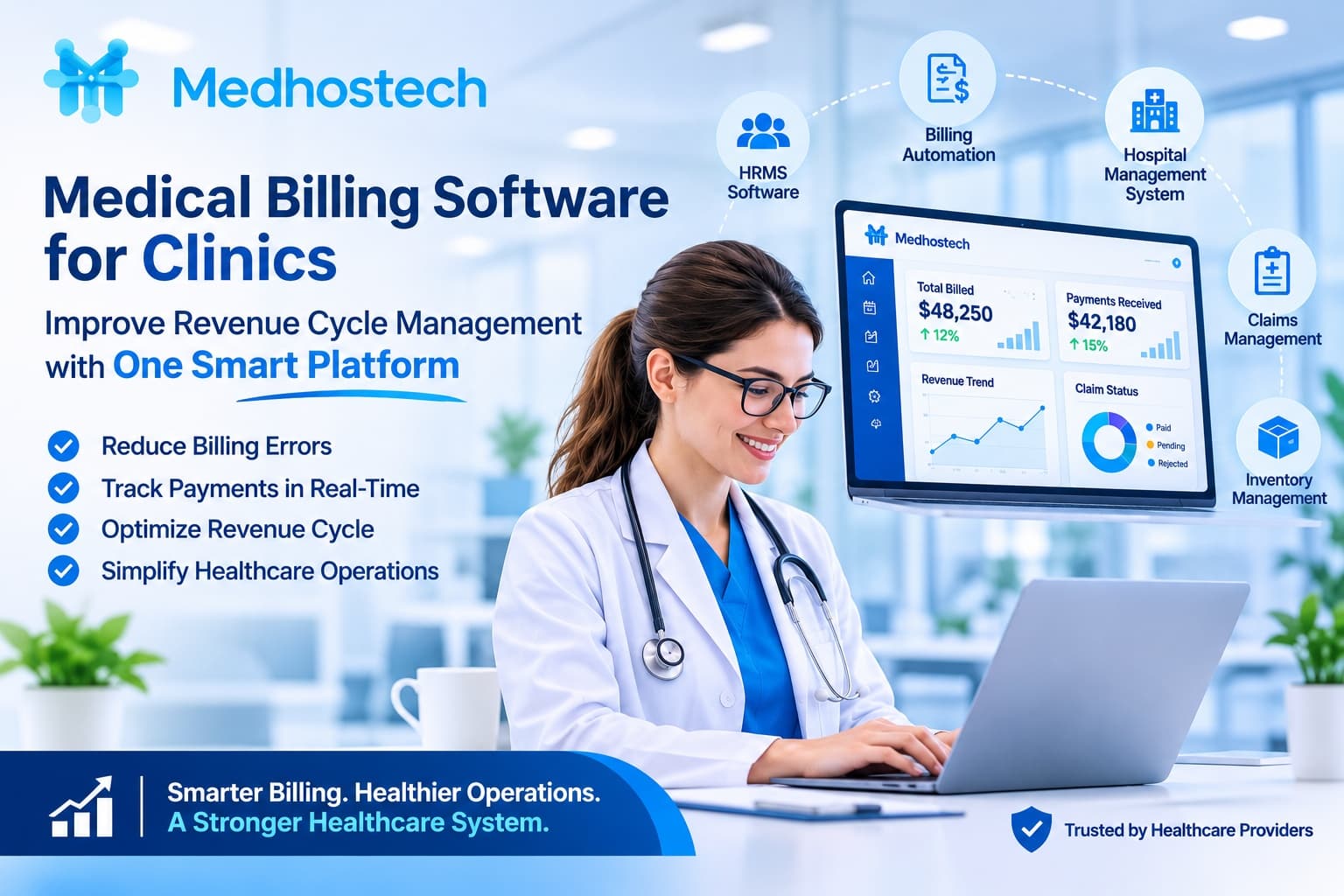
Discover how medical billing software helps Massachusetts clinics improve revenue cycle management, streamline payments, and simplify healthcare operations.
Medhostech Editorial
Healthcare IT & software insights
How Medical Billing Software Helps Massachusetts Clinics Improve Revenue Cycle Management
Healthcare clinics in Massachusetts handle several financial and administrative responsibilities every day, from patient registration and billing to payment tracking and insurance claim processing. Managing these activities manually can create delays, increase administrative workloads, and make it difficult to maintain accurate financial records.
Efficient revenue cycle management (RCM) is essential for maintaining the financial stability of healthcare practices. It covers the complete financial process, starting with patient registration and ending with final payment collection. With the right technology, clinics can simplify these processes and improve their financial performance.
Medical billing software helps healthcare providers organize billing activities, reduce repetitive work, monitor payments, and maintain better financial visibility. For clinics looking to improve their daily operations, adopting modern billing solutions can make a meaningful difference.
What Is Revenue Cycle Management in Healthcare?
Revenue Cycle Management (RCM) refers to the financial process healthcare organizations follow to manage payments for medical services. It begins when a patient schedules an appointment or registers at a clinic and continues until the payment is collected and recorded.
A typical revenue cycle includes:
Patient registration and information collection
Insurance eligibility verification
Medical coding and charge entry
Invoice and claim generation
Payment processing
Claim follow-ups and denial management
Financial reporting and reconciliation
When these activities are handled through disconnected systems or spreadsheets, important information can become difficult to track. Medical billing software helps bring these activities into a more organized workflow.
How Medical Billing Software Improves Revenue Cycle Management in Massachusetts Clinics
1. Reduces Manual Billing Errors
Manual billing involves repetitive data entry, calculations, and record management. Even small mistakes in patient details, service charges, or billing information can lead to payment delays and additional administrative work. Billing software helps organize financial information and standardize billing workflows. Depending on the system's capabilities, it can support automated calculations, invoice generation, and accurate recordkeeping.
For clinics using billing software in Massachusetts, reducing avoidable errors can improve administrative efficiency and make financial processes easier to manage.
2. Speeds Up Invoice Generation and Payment Tracking
Delayed invoices can affect cash flow and create unnecessary follow-up work for administrative teams. Medical billing systems help clinics generate invoices, record payments, and monitor outstanding balances in one place. Staff can quickly review payment statuses and identify accounts that may require attention.
Some platforms also support digital payment options, allowing patients to complete payments more conveniently. This creates a more transparent billing process for both patients and healthcare administrators.
3. Improves Insurance Claim Management
Insurance claim management is an important part of the revenue cycle for many healthcare practices in the United States. Incomplete information, incorrect coding, and missing documentation can contribute to claim rejections or denials. Billing software can help organize patient and billing records, support claim preparation, and make it easier to review outstanding claims.
However, claim submission, eligibility verification, and electronic clearinghouse integration depend on the software's specific features and integrations.
For Massachusetts healthcare providers, a well-organized claim management process can reduce administrative confusion and support more consistent reimbursement workflows.
4. Provides Better Financial Visibility
Healthcare administrators need accurate financial information to understand how their clinics are performing. Without centralized records, it can be difficult to identify outstanding payments, review revenue trends, or understand where billing delays occur.
Modern billing platforms may provide dashboards and reports that help administrators monitor:
Total invoices generated
Payments received
Outstanding balances
Daily and monthly revenue
Pending transactions
Billing activity and financial trends
Having this information readily available helps clinic managers make informed operational decisions.
5. Reduces Administrative Workload Through Automation
Medical billing automation U.S.A. is becoming increasingly relevant as healthcare organizations look for ways to reduce repetitive administrative tasks. Automation can support activities such as invoice generation, payment reminders, transaction recording, and routine reporting.
Instead of spending hours maintaining separate records, administrative employees can focus more on patient communication and other important responsibilities. The exact level of automation depends on the platform and its available features.
Why Massachusetts Clinics Need Integrated Healthcare Management Software
Billing is only one part of healthcare administration. Clinics also manage employees, schedules, patient information, operational records, and other daily responsibilities. Using separate tools for each activity can create disconnected workflows and increase the effort required to manage information.
An integrated hospital management system in Massachusetts can help healthcare organizations coordinate different administrative functions through a centralized platform.
For example, connecting billing workflows with staff management and other operational activities can help administrators maintain better oversight of their clinics.
The Role of HRMS Software in Healthcare Operations
HRMS software plays an important role in managing the workforce behind healthcare services. Healthcare administrators regularly handle employee information, attendance, scheduling, payroll, and staff-related documentation. An integrated approach to HRMS and billing management can help clinics organize employee administration alongside their financial operations.
This is particularly useful for growing healthcare practices that want to reduce administrative complexity without relying on multiple disconnected systems.
What Should Massachusetts Clinics Look for in Medical Billing Software?
Before choosing a billing solution, healthcare providers should evaluate their operational requirements and the software's capabilities.
Important features to consider include:
1. Easy-to-use dashboard: A centralized interface makes it easier to review billing activities and access important information.
2. Invoice generation: The system should support accurate invoice creation and organized financial records.
3. Payment tracking: Administrators should be able to monitor received, pending, and outstanding payments.
4. Reporting and analytics: Financial reports help clinics understand revenue trends and identify areas that need improvement.
5. Integration capabilities: The ability to connect billing with other healthcare management functions can reduce duplicate work.
6. Data security: Healthcare providers should evaluate access controls, encryption, data handling, and applicable regulatory requirements, including HIPAA where relevant.
7. Scalability: The software should be suitable for the clinic's current requirements and future growth.
Choosing the right platform requires evaluating not only its features but also how well it fits the clinic's existing workflows.
How Medhostech Helps Simplify Healthcare Management
Managing billing and administrative responsibilities does not have to involve multiple disconnected systems. Medhostech offers a cloud-based business management platform designed to help healthcare organizations streamline important operational activities through a centralized environment.
With capabilities across healthcare management, HRMS, and billing workflows, Medhostech aims to make daily administration more organized and manageable. Its centralized approach helps businesses improve operational visibility, coordinate administrative responsibilities, and reduce dependence on scattered information.
For healthcare providers exploring modern billing and management solutions, Medhostech offers an approach focused on simplifying everyday business operations.
Frequently Asked Questions (FAQs)
1. What is medical billing software?
Medical billing software is a digital solution that helps healthcare providers manage invoices, payment records, billing information, and financial workflows. Depending on its features, it may also support insurance claims and payment processing.
2. How does medical billing software improve revenue cycle management?
It helps organize billing activities, reduce manual errors, monitor outstanding payments, and improve financial reporting. These improvements can help healthcare organizations manage their revenue cycle more efficiently.
3. Why do Massachusetts clinics need medical billing software?
Massachusetts clinics handle patient billing, payment records, insurance-related documentation, and financial administration. Billing software can simplify these activities, improve record organization, and reduce repetitive administrative work.
4. Can medical billing software reduce claim denials?
It can help reduce avoidable errors by organizing patient information and supporting accurate billing workflows. However, claim denials can also result from coverage limitations, coding issues, and payer-specific requirements, so software alone cannot eliminate them.
5. What is the difference between medical billing software and a hospital management system?
Medical billing software primarily focuses on financial activities such as invoicing, payment tracking, and billing records. A hospital management system covers broader administrative functions, which may include staff management, patient administration, billing, and operational workflows.
6. How does medical billing automation help healthcare providers in the USA?
Medical billing automation can reduce repetitive tasks such as invoice generation, payment recording, and routine reporting. It helps administrative teams save time and maintain more organized financial records.
7. Can HRMS software and medical billing software work together?
Yes. When integrated or available through a common platform, HRMS and billing solutions can help healthcare organizations manage workforce administration and financial operations more efficiently.
8. What should clinics consider before selecting billing software?
Clinics should evaluate ease of use, billing features, payment tracking, reporting, integration capabilities, data security, regulatory requirements, and scalability before selecting a solution.
Conclusion
Efficient revenue cycle management is essential for healthcare clinics that want to maintain financial stability while delivering quality patient care. From reducing manual billing errors to improving payment tracking and financial visibility, medical billing software can simplify many everyday administrative responsibilities. For Massachusetts healthcare providers, investing in the right technology can also create opportunities to connect billing, HRMS, and broader healthcare management activities through more organized workflows.
Medhostech helps bring business management activities together through a centralized, cloud-based platform. By simplifying administrative processes and supporting better operational coordination, Medhostech aims to help healthcare organizations focus less on management complexity and more on delivering effective services.
Medhostech – Build. Automate. Grow.
Explore smarter business management solutions at https://medhostech.com/.